The New Craft Gap
AI can generate in seconds what used to take years to learn. But the things we lose in that acceleration might be the things that mattered most.

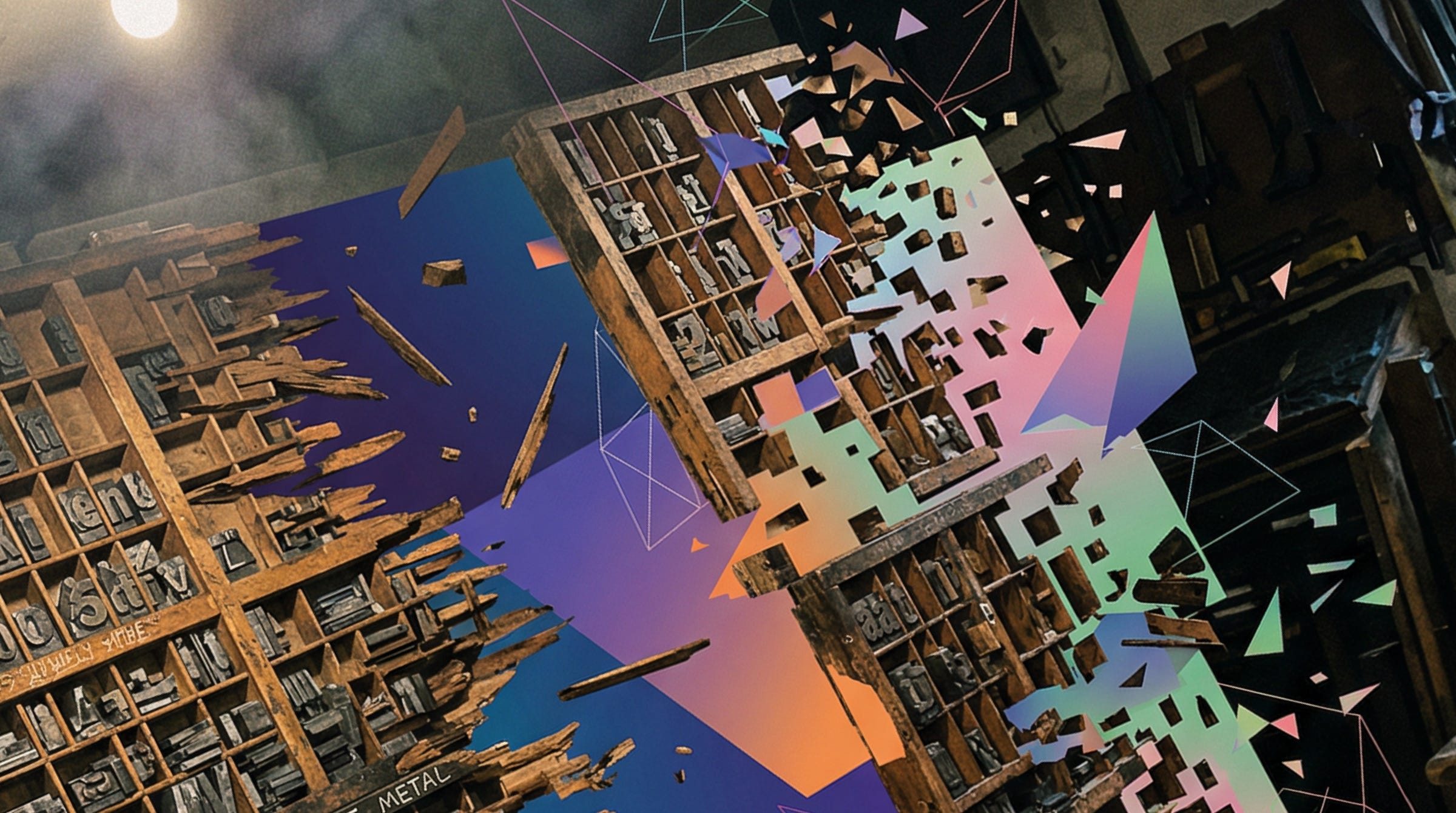
I spent the first several years of my design career doing work nobody would ever put in a portfolio: spacing elements on a grid until they felt right, kerning headlines letter by letter, building style tiles (some of you remember those?) that got rejected, rebuilding them, getting rejected again. Pushing pixels on screens that no one would ever see because the client changed direction on a Thursday afternoon call.
None of that was glamorous, but all of it was necessary for my personal growth. Those hours of ungrateful production work are where I learned to develop my eye for design, not specifically in a lecture or a tutorial (although those were helpful too). I learned things in the accumulation of thousands of small decisions made badly, then less badly, then with something that started to feel inevitable.
Most of those tasks in the minutiae can now be done by a machine in the time it takes to type a sentence. Now, someone can generate a full brand identity in under two minutes. Logo, color palette, type pairings, social templates, all the swag. It can look competent, polished, and—importantly—completely devoid of a point of view, like a beautifully set table with no food on it.
This generated output is getting closer to passable, and passable is sadly all that most of the market has ever asked for.
Expertise Split
The World Economic Forum’s 2025 Future of Jobs report identified graphic design as the 11th fastest-declining job category over the next five years. But two years earlier, the same report had classified it as “moderately growing.” The reversal was tied directly to AI’s increasing ability to perform visual and creative tasks.
A less-discussed data point in the report gives nuance to the story: UI/UX design was named among the top 10 fastest-growing roles. The picture isn’t a uniform decline, but a split in expertise. Static visual production is contracting, but experience design, the kind that requires understanding of people, systems, and context, is growing. A lot of careers are going to be made or broken in the widening gap between those two trajectories.
Figma’s 2026 hiring study sharpened this further. 56% of hiring managers say there’s increasing demand for senior designers, compared to just 25% hiring for junior roles. 73% want AI proficiency. The industry wants senior people who already know what they’re doing. Meanwhile, the entry points for new designers are narrowing considerably. Figma’s own Code to Canvas partnership with Anthropic, which converts AI-generated code into editable design components, compresses the kind of production work that junior designers used to cut their teeth on.
I know the skill set for entry-level designers is very different now than when I cut my teeth, but the reality is that the industry is demanding senior designers while eliminating the junior work that produces them. Every skilled designer I know learned their craft by doing bad work for a long time. That pipeline of unglamorous, incremental skill-building is what produces mastery, and it’s also the part most vulnerable to automation.
Homogeneity
If you work in branding or interface design, you’ve already noticed a particular kind of blandness spreading across the visual web: a pleasant but expressionless aesthetic that looks like it was all designed by the same person. Circling wagons around what works is an important aspect of design evolution, but where’s the feeling, the emotion, the human connection, the vitality?
When you can generate a “complete brand identity” from a text prompt, the output converges on whatever the model learned from its training data. And its training data is the entire visible history of branding on the internet, averaged. You can see it in the logo generators, in the social templates populating every small business Instagram feed, in the Canva-fied sameness of pitch decks and marketing sites. The output isn’t ugly per se, but it is forgettable.
The best branding I’ve ever worked on took months. Not because the team was slow, but because the process of understanding a brand, sitting with its contradictions, and arriving at something that actually means something cannot be compressed into a single prompt conversation that follows the same basic loop: prompt, review, tweak, repeat until you're happy.
But the thinking from a human is the design. When you skip the thinking, sure, you get a logo, but you don’t get a brand that came from a depth of feeling and heart.
Other Mediums
Yeah, more negativity is coming. I’m sorry; I’m kind of bummed by all of this. The same rinse and repeat pattern is hitting music and video, and the numbers there are just as alarming.
Deezer’s AI-detection system found that 50,000 AI-generated tracks are uploaded to its platform every day, accounting for 34% of all new music. Sony requested the removal of more than 135,000 AI songs impersonating its artists in March alone. A website called Slop Tracker launched this week, showing that just 50 AI-generated “artists” on Spotify have earned roughly $2.7 million, every dollar drawn from a royalty pool that would otherwise go to real musicians who really care about what they’re gifting to the world. Murphy Campbell, a folk musician from North Carolina, found AI-generated songs on her streaming profiles that she’d never heard, uploaded without her knowledge. She didn’t know she’d “released” new music until fans started messaging her.
In early 2025, more than 1,000 musicians, including Kate Bush, Hans Zimmer, and Damon Albarn, released a silent album called Is This What We Want? The tracks consist of ambient noise recorded in empty studios, and the track titles spell out: “The British Government must not legalise music theft to benefit AI companies.” Paul McCartney added a bonus track for the vinyl: tape hiss and indeterminate clattering. The barely listenable silence was the statement.
Motion and video are also on the same arc. OpenAI shut down Sora last week, its billion-dollar Disney partnership dissolving alongside it. But the market Sora opened didn’t close with it. ByteDance’s Seedance 2.0, Google’s Veo 3, and others are filling the space.
What connects all of this—across design, music, and film (I typed these appropriate em-dashes)—is the same dynamic: human craft becomes training data, the training data becomes a product, and the product competes with the humans whose painstaking work made it possible.
The Joy of Slow Work
I think nostalgia is a lousy basis for making career decisions. I don’t think we should reject AI tools to preserve some romantic idea of the suffering designer. But the slow part is where the meaning lives. When I was learning to design, the hours of production weren’t just an obstacle between me and competence. They were the joy of the work itself: The feeling of a layout finally clicking after you’ve rearranged it eleven times, the moment when you stop fighting the grid and start feeling the negative space, the slow discovery that typography isn’t about choosing a font but about controlling rhythm and allowing the proper breathing room on a page to complement a brand’s topology.
You can generate a brand kit in two minutes, but you can’t generate the experience of having designed one. The deliverables might look similar, but the designer who made it sure as hell won’t be.
The Craft Gap
If all of this sounds bleak for the craftsman/creative’s will to derive meaning through their work, I think it is. But there are some countervailing efforts in the works. iHeartRadio launched a “Guaranteed Human” program, and their research found that 96% of consumers find the concept appealing. Bandcamp banned AI-generated music entirely. A job listing making the rounds states outright: “We are not looking for AI-generated design output. This role requires strong human design judgment, taste, and original execution.” The handmade goods market is valued at over $900 billion globally and growing at nearly 9% per year. The more the world fills design with generated output, the more people seem to crave things that carry the evidence of having been made by someone.
The craft gap is real and the junior pipeline is narrowing, but none of these are wholly consequences of new technology. They can be consequences of choices. A Stanford and UCLA study found that when a major image marketplace allowed AI-generated art alongside human work, consumers chose the AI images, sales rose, and human-generated images fell dramatically. That should worry all of us. But I strongly believe that the market doesn’t have to be the only voice in the room.
There are things I have a deep passion for that are worth building:
Studios that commit to mentorship pipelines and not just senior hires
Compensation models for the designers whose portfolios trained the models competing with them
Team cultures that value the process of designing, not just the deliverables
I still open my design tools most mornings and push things around until they feel right, but most of those mornings I also use AI to speed up parts of the process. Increasingly, some days I deliberately don’t use AI at all in my design process. Those days are much slower, but surprisingly cathartic, because the slow version always teaches me things and gives me pleasure in ways the fast version can’t. I’d like to figure out how to help the next generation of designers feel that sense of pain, pleasure, and personal growth too.
This is the third installment of Dispatches on AI, a series on how generative AI is reshaping design, development, and the integrity of the web:
Exploring AI’s Impact on Digital Creation (series intro)
The New Craft Gap
Who Needs an Engineer? (April 7)
Subscribe to get each post in your inbox.
Sources and Further Reading
WEF Future of Jobs 2025: Design Week | BEDA
Figma 2026 hiring study: Figma Blog
Figma x Anthropic: TheStreet
Stanford/UCLA marketplace study: Stanford GSB
AI music streaming crisis: TIME | Rolling Stone
Is This What We Want?: isthiswhatwewant.com | NBC News
Sora shutdown: IndieWire
Guaranteed Human: TIME
I realize there are some designers who are wired to thrive in this new fast-design paradigm and appreciate the gains in speed, but these thrivers I know have already been through the "slow zone" (hat tip to Vernor Vinge). I'm very curious to see how the up-and-comers will approach their craft.